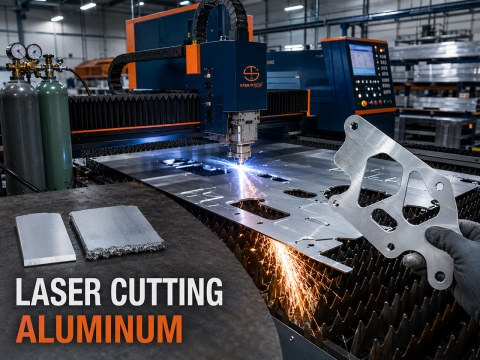
Galvanized steel is everywhere in fabrication: HVAC ducting, enclosures, agricultural equipment, automotive panels. Cutting it is a routine, safe production process on a correctly equipped machine, and a genuine health hazard on one without fume handling. This guide covers the physics, the illness, the extraction requirements that decide the safety question, and the parameter and edge-rust details that decide cut quality.
What Happens When the Laser Hits Zinc
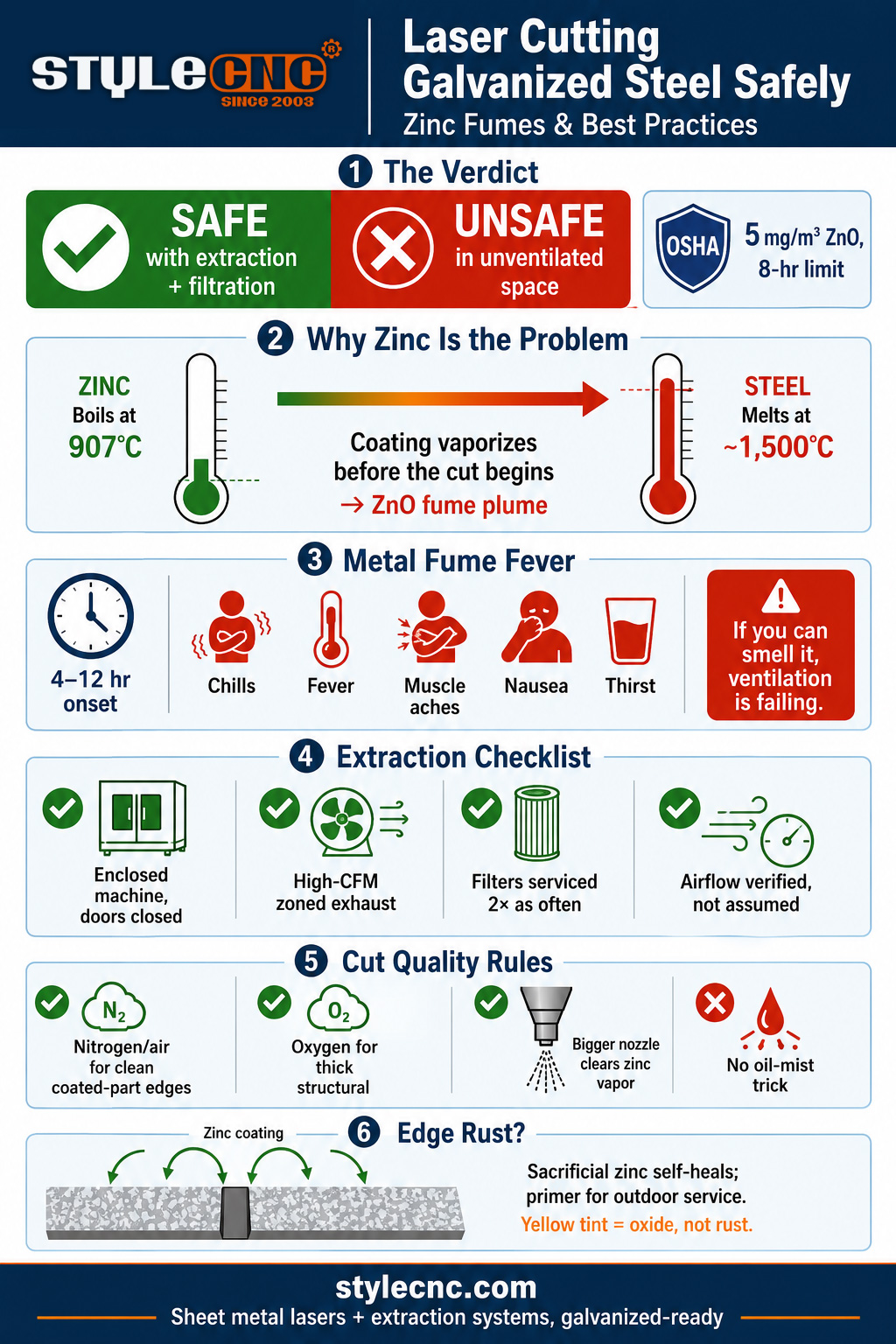
Galvanized steel is ordinary carbon steel wearing a thin zinc jacket, and the 2 metals part ways the instant the beam arrives. Zinc boils at roughly 907 degrees C, far below the temperature at which steel even fully melts. So before the cut proper begins, the coating around the kerf flashes into vapor, reacts with oxygen, and erupts as a plume of fine white zinc oxide particulate riding the assist gas out of the cut.
That plume is the entire safety story. The steel itself cuts like any mild steel; the vaporized coating is what fills an unventilated shop with white haze and puts the operator at risk. Solve the fume, and galvanized becomes routine work.
Metal Fume Fever: The Hazard by Name
Inhaled zinc oxide fume causes metal fume fever, the illness welders call the zinc shakes or Monday morning fever. Symptoms arrive 4 to 12 hours after exposure: chills, fever, muscle aches, nausea, and unusual thirst, typically resolving within about a day. NIOSH literature reports no known long-term effects from isolated episodes, but repeated exposure is linked to lasting respiratory problems.
The regulatory line is concrete: OSHA's permissible exposure limit for zinc oxide fume is 5 milligrams per cubic meter averaged over an 8-hour shift, with NIOSH setting the same recommended limit. The practical shop translation used across the industry is blunt and useful: if you can smell the fume or see haze in the air, the extraction is insufficient and the limit is likely being exceeded.
Fume Extraction: The Requirement That Decides the Answer
Every credible answer to the safety question, from occupational health literature to machine manufacturers, converges on the same point: extraction and filtration are the deciding factor. The working checklist:
✓ Enclosed machine, doors closed: An enclosure turns the fume plume from a room problem into a duct problem. Open-frame cutting of galvanized indoors is the scenario that produces sick operators.
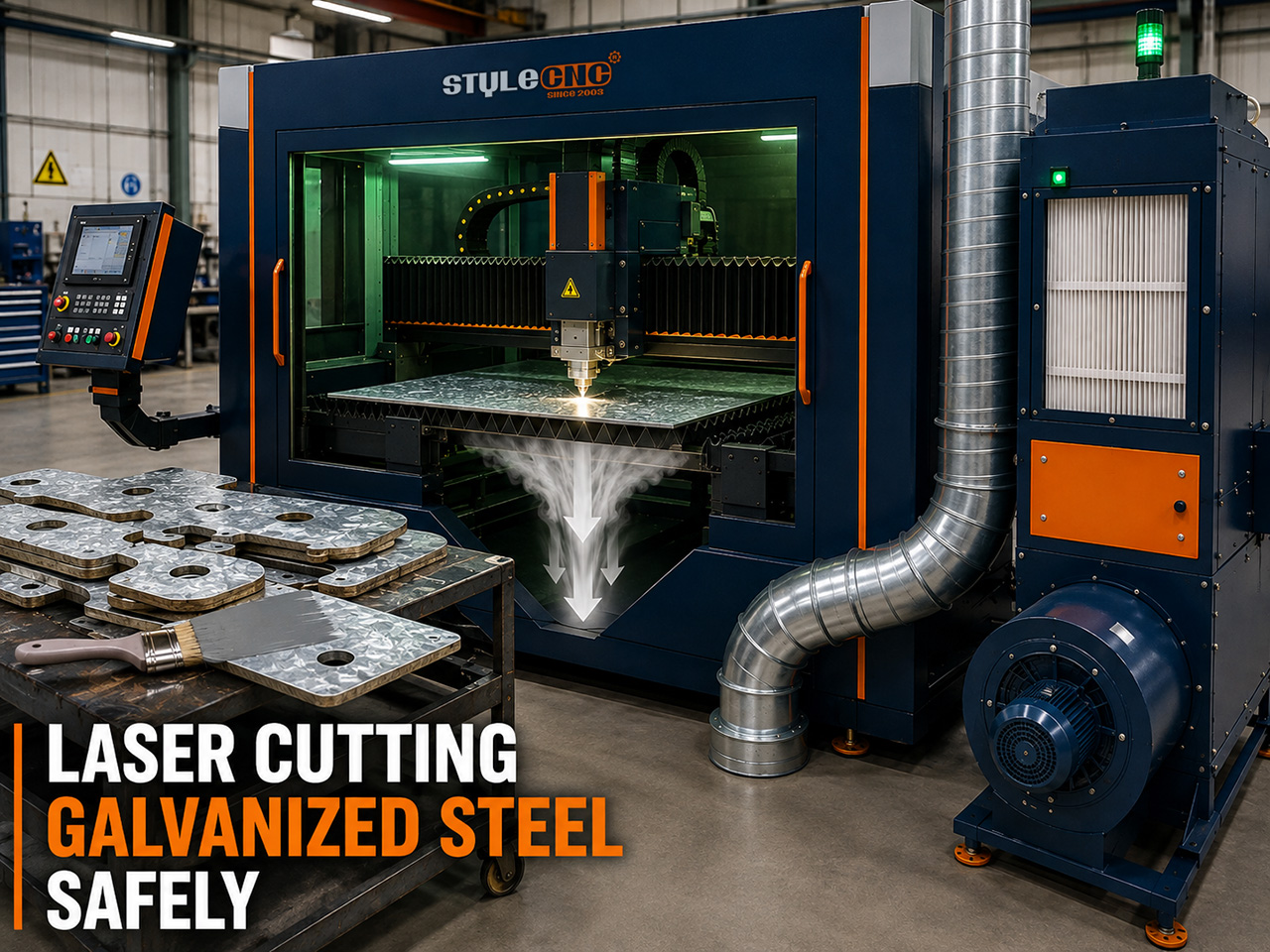
✓ High-flow exhaust matched to the bed: A dedicated high-CFM exhaust fan and dust collector pulls the plume down and out before it escapes the enclosure. Zoned or segmented extraction, which concentrates suction where the head is cutting, handles heavy galvanized work best.
✓ Filtration serviced on an accelerated schedule: Zinc oxide particulate is fine and sticky and loads filters roughly twice as fast as mild steel dust. A clogged filter quietly turns a compliant system into a non-compliant one, so inspection intervals for galvanized work should be tighter than the steel-only schedule.
✓ Airflow verified, not assumed: The smell-and-haze test is the everyday check; periodic air monitoring against the 5 mg/m3 limit is the formal one for shops running galvanized at volume.
On the machine side, STYLECNC laser systems pair with the exhaust fan and dust collector for laser cutting machines for exactly this duty, and the ليزر ڪٽر حفاظتي ھدايت covers the full operating checklist that fume handling slots into.
One more reason extraction pays for itself: zinc dust is electrically conductive and abrasive. Left uncollected, it settles into control cabinets and bridges circuit boards, coats the cutting lens until absorbed heat cracks it, and grinds away at motion components. Fume handling protects the machine as much as the operator.
Cutting Parameters and Assist Gas for Galvanized Sheet
Quality problems on galvanized trace back to the same low-boiling zinc: spatter near the kerf, bottom dross, and coating peel along the edge. The countermeasures are parameter-level.
✓ Assist gas by outcome: Nitrogen or high-pressure air gives the cleanest, oxide-minimal edge for parts that will be seen or powder-coated; expect a normal yellow-tan tint on the cut face. Oxygen cuts thicker sheet faster and cheaper at the cost of a more oxidized edge. Both are legitimate; choose by the part's next process.
✓ Larger nozzle for the vapor load: Nozzles around 1.5 to 2.5 mm, sized up with thickness, move the gas volume needed to clear zinc vapor from the kerf before it redeposits as spatter and dross.
✓ Speed is your friend: Higher power cutting faster gives the heat less time to spread, which directly reduces zinc peeling and the burned-coating margin along the edge. A fast clean pass beats a slow careful one on this material.
✗ Skip the oil-mist trick: Some operators mist oil on the sheet to stop spatter sticking. It works for spatter and backfires everywhere else, adding smoke to the fume load and contaminating the lens. Proper gas settings and good nozzles solve the same problem cleanly.
Will Laser-Cut Galvanized Edges Rust?
The cut edge is bare steel where the beam removed the coating, but 2 things protect it. Zinc corrodes sacrificially, so the surrounding intact coating electrochemically defends the narrow exposed band, partially self-healing the cut line. For indoor and sheltered applications the edge typically performs fine as cut, and the yellow-tan oxide tint is cosmetic, not a failure sign.
For outdoor, marine, or high-humidity service, restore the barrier: brush or spray zinc-rich primer on cut edges, or specify post-cut touch-up in the finishing routine. Parts headed for powder coat get their protection back from the coating system itself, which is a more reason the cleaner nitrogen or air edge is worth choosing for coated work.
The Right Machine Setup for Galvanized Work
Galvanized sheet is core territory for the شيٽ ڌاتو ليزر cutter class: enclosed fiber laser platforms in the thin-to-medium gauge range where ducting, enclosures, and panel work live, configured with the exhaust and filtration circuit that makes the safety answer yes. Send the STYLECNC team your gauges, monthly volume, and shop ventilation situation for a configuration that covers both the cut quality and the air quality sides of galvanized production.
وچان وچان سوال ڪرڻ
Can you laser cut galvanized steel?
Yes, routinely. Fiber lasers cut galvanized sheet in production across HVAC, enclosure, automotive, and agricultural fabrication. The steel substrate cuts like ordinary mild steel; the zinc coating is the complicating factor, vaporizing into zinc oxide fume that must be captured by the machine's extraction system. On an enclosed machine with working fume handling, it is a standard job. Without extraction, it is the one common material that can make an operator genuinely ill.
What do zinc fumes do to you?
Inhaled zinc oxide causes metal fume fever: chills, fever, muscle aches, nausea, and marked thirst arriving 4 to 12 hours after exposure and resolving in roughly a day. NIOSH literature reports no known long-term harm from an isolated episode, but repeated exposure is linked to chronic respiratory problems. OSHA's exposure limit is 5 mg/m3 of zinc oxide fume averaged over 8 hours, and the practical rule is stricter: if you can smell it, fix the ventilation.
What assist gas is best for galvanized steel?
Choose by the part's destination. Nitrogen or high-pressure compressed air gives the cleanest edge with minimal oxide, the right pick for visible parts and anything headed to powder coat; the yellow-tan tint it leaves is normal. Oxygen cuts thicker galvanized faster and cheaper with a more oxidized edge, fine for structural work. Either way, run a larger nozzle than plain steel would need, because clearing the zinc vapor is what prevents spatter and dross.
Do laser-cut galvanized edges rust?
Slower than the bare-steel edge suggests. Zinc protects sacrificially, so the intact coating beside the cut electrochemically defends the narrow exposed band, and indoor or sheltered parts generally perform fine as cut. For outdoor or humid service, touch up cut edges with zinc-rich primer or rely on the downstream coating system. The yellow discoloration on nitrogen or air cuts is surface oxide, not rust, and not a defect.
Is special ventilation required, or is shop air enough?
Standard shop ventilation is generally not enough for galvanized at production volume; the consensus across manufacturers and safety literature is a dedicated extraction and filtration system on an enclosed machine. Zinc oxide particulate also clogs filters about twice as fast as mild steel dust, so galvanized-heavy shops need tighter filter service intervals. Enclosure closed, exhaust on, filters fresh, no smell: that is the operating standard.
تري لائين
The safety of laser cutting galvanized steel is not a property of the material; it is a property of the machine setup. Zinc will vaporize every time, metal fume fever is real, and the OSHA limit is specific. An enclosed machine with high-flow extraction, fresh filtration, and a no-smell standard makes galvanized a routine material. Add the right gas, a bigger nozzle, honest speed, and zinc-rich primer where the service environment demands it, and both the operator and the parts come out fine.
STYLECNC ترتيب ڏئي ٿو sheet metal fiber lasers سان extraction and dust collection systems galvanized work requires. Ask the team for a galvanized-ready configuration matched to your gauges and volume.